
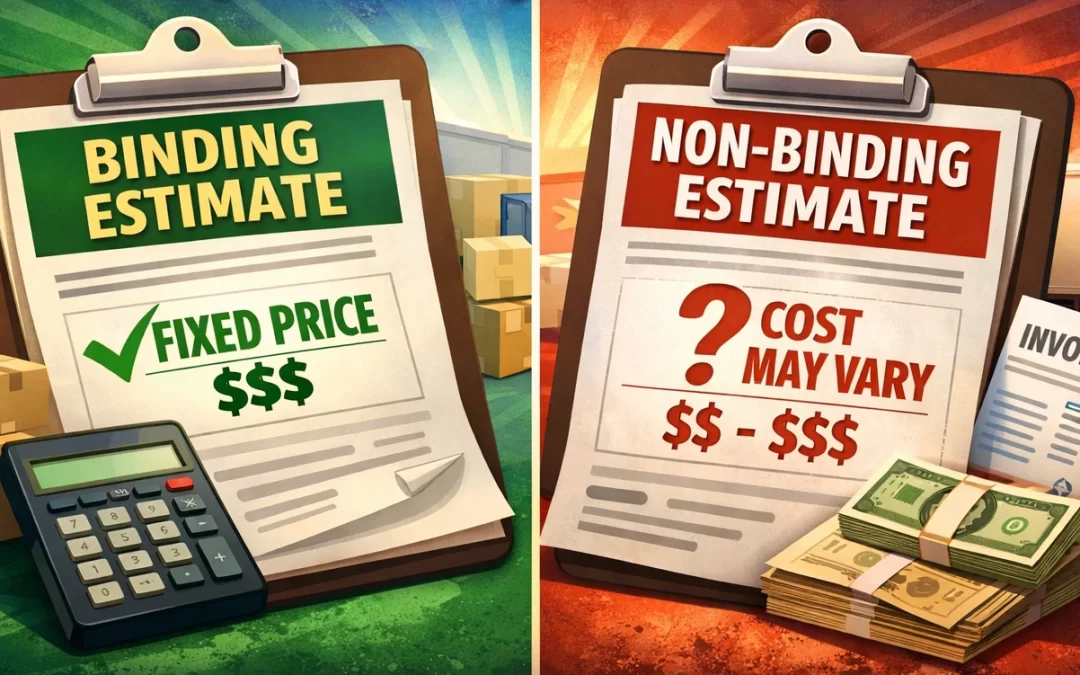
Short answer: Moving quotes are usually provided as binding estimates, non-binding estimates, or binding not-to-exceed estimates, and each type determines how your final moving cost is calculated.
Moving quotes can be confusing because different companies use different estimate types and different assumptions about weight, services, and access conditions.
Understanding how each estimate works helps you compare movers fairly, avoid surprises on moving day, and budget more accurately.
Table of Contents
- Why Understanding Moving Estimates Matters
- How Moving Quotes Are Calculated
- Binding Estimates Explained
- Non-Binding Estimates Explained
- Binding Not-to-Exceed Estimates
- Comparing Moving Estimate Types
- What Should Be Included in a Moving Quote
- How to Verify a Moving Company Is Licensed
- Tips for Comparing Moving Quotes
- Final Thoughts
Why Understanding Moving Estimates Matters
When planning a move, one of the first questions most homeowners ask is: “How much will this move cost?”
The answer depends largely on the type of estimate provided by the moving company.
Many disputes between movers and customers occur because people do not fully understand the difference between binding estimates and non-binding estimates.
Without that knowledge, it can be difficult to compare quotes accurately or anticipate the final cost of a move.
Understanding how moving estimates work allows homeowners to:
- Budget more accurately
- Compare movers fairly
- Avoid unexpected charges
- Choose the most appropriate pricing option for their move
Before signing any moving contract, it is important to understand exactly what type of estimate you are receiving.
How Moving Quotes Are Calculated
For interstate moves, pricing is typically based on several key factors.
Unlike local moves, which are often billed hourly, long-distance moves are usually calculated using shipment weight and distance.
Factors that affect moving estimates
- Weight or volume of household goods
- Distance between the origin and destination
- Packing services requested
- Storage requirements
- Accessibility (stairs, elevators, long carries)
To create an accurate estimate, reputable movers will usually perform either:
- An in-home survey of your belongings, or
- A virtual video inventory survey
This allows the company to calculate the expected shipment weight and determine the services required.
Once the inventory is complete, the moving company will provide a written estimate outlining the projected cost of the move.
Binding Estimates Explained
A binding estimate is a fixed price agreement between the customer and the moving company.
Under this type of estimate, the price of the move will not change as long as the inventory and requested services remain the same.
In other words, the final price is guaranteed based on the items that were originally listed.
Key characteristics of binding estimates
- The price is fixed before the move
- The cost will not increase if shipment weight is higher than expected
- Additional items or services may result in extra charges
Binding estimates provide a high level of price certainty, which many homeowners prefer when planning a move.
However, if the customer adds more items or requests additional services that were not included in the original inventory, the price may increase accordingly.
Non-Binding Estimates Explained
A non-binding estimate is an approximate estimate of the expected cost of a move.
It is based on the estimated weight of the shipment and the services requested, but the final price may change depending on the actual weight of the items being transported.
Key characteristics of non-binding estimates
- The estimate is not a guaranteed price
- The final cost is determined after the shipment is weighed
- The final price may increase or decrease
This type of estimate may be appropriate when it is difficult to determine the exact inventory or shipment weight.
However, homeowners should be aware that the final price can sometimes be significantly higher than the original estimate if the shipment weighs more than expected.
Binding Not-to-Exceed Estimates
Some moving companies offer a third option known as a binding not-to-exceed estimate.
This type of estimate combines elements of both binding and non-binding pricing.
With a binding not-to-exceed estimate:
- The final price will never exceed the quoted amount
- The price may decrease if the shipment weighs less than estimated
This structure provides price protection while also allowing homeowners to benefit if their shipment is lighter than expected.
Because of this balance, many moving experts consider binding not-to-exceed estimates to be the most consumer-friendly option when available.
Comparing Moving Estimate Types
Understanding the differences between estimate types can make it easier to evaluate offers from different movers.
Moving Estimate Comparison
| Estimate Type | Price Guarantee | Risk Level | Best For |
| Binding | Fixed price | Low | Homeowners who want price certainty |
| Non-Binding | Final price based on weight | Moderate | Moves with uncertain inventory |
| Binding Not-to-Exceed | Price cannot exceed estimate | Very Low | Balanced price protection |
Each type of estimate has advantages depending on the specific circumstances of the move.
What Should Be Included in a Moving Quote
A legitimate moving estimate should clearly outline all details related to the move.
Consumers should carefully review the estimate to ensure the following information is included.
Information typically included in moving estimates
- Pickup and delivery locations
- Inventory of items being moved
- Estimated shipment weight
- Total estimated price
- Type of estimate provided
- Additional services requested
- Insurance or valuation coverage
If any of these details are missing or unclear, homeowners should request clarification before signing the agreement.
How to Verify a Moving Company Is Licensed
Interstate moving companies must be registered with the Federal Motor Carrier Safety Administration (FMCSA).
Each authorized mover receives a USDOT number, which serves as a unique identifier for the company.
Consumers can verify a mover’s licensing and complaint history through the FMCSA’s consumer protection website:
https://www.protectyourmove.gov
By searching the company name or USDOT number, homeowners can confirm:
- Licensing status
- Insurance coverage
- Company contact details
- Consumer complaints
Checking this information before hiring a mover is one of the most effective ways to avoid fraudulent companies.
Tips for Comparing Moving Quotes
Because moving companies may structure estimates differently, comparing quotes requires careful attention to detail.
Helpful tips when reviewing moving estimates
- Request at least three estimates
Multiple quotes help establish a realistic price range for the move.
- Compare services, not just price
Some companies may include packing materials, storage, or insurance in their estimates while others charge separately.
- Understand the estimate type
Knowing whether a quote is binding or non-binding helps prevent surprises later.
- Review the inventory carefully
Ensure all items being moved are listed correctly in the estimate.
Homeowners planning an interstate relocation often benefit from reviewing several offers. One way to better understand realistic pricing is to compare long-distance moving quotes from multiple licensed movers before making a decision.
Final Thoughts
Moving estimates play an important role in determining the final cost of a relocation.
Understanding the differences between binding, non-binding, and binding not-to-exceed estimates can help homeowners avoid misunderstandings and unexpected charges.
By reviewing estimates carefully, verifying company credentials, and comparing multiple quotes, consumers can make more informed decisions when selecting a moving company.
Taking the time to understand these details can provide valuable peace of mind during what is often a stressful process.
About the Author
This article was written by the team at Rex Direct, the owners of QuickMovingQuotes.com.
Rex Direct supports businesses and consumers throughout the moving industry by providing technology and data solutions that help homeowners compare moving services, understand pricing, and make informed relocation decisions.
Through their work with movers, relocation platforms, and lead generation services, the Rex Direct team has developed extensive insight into how interstate moving companies operate and how consumers can protect themselves during the moving process.