
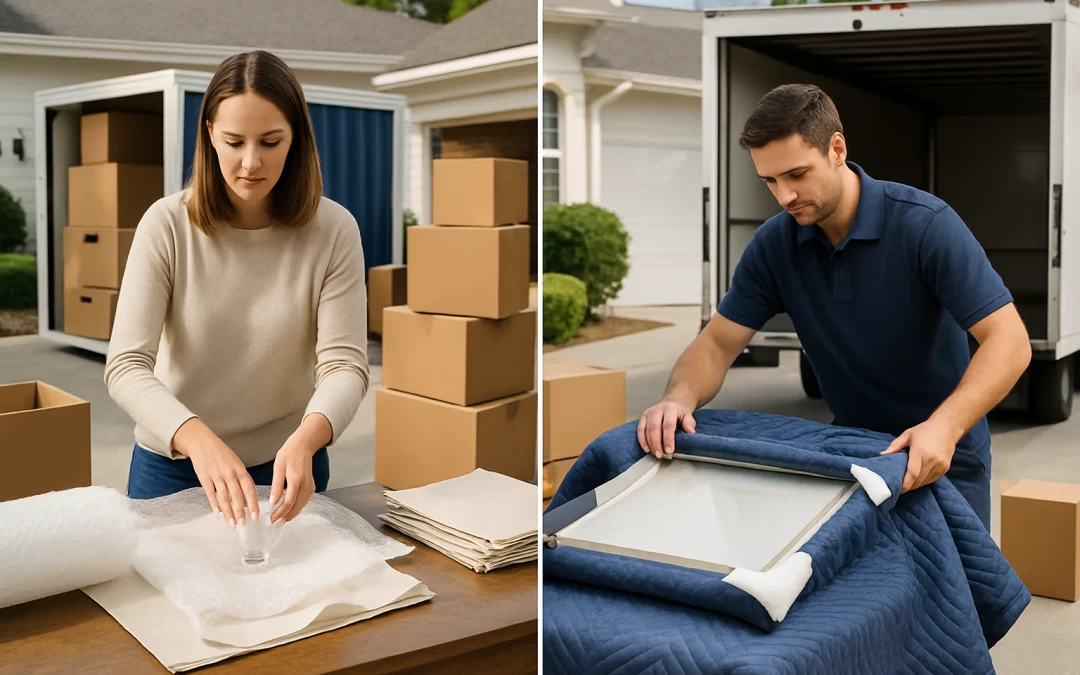
Self-pack moving containers are usually cheaper and give you more control, but they put all the responsibility for protecting fragile items on you. Full-service packing is typically safer for delicate belongings because trained movers bring the right materials and techniques, but it costs more and you’ll need to schedule and supervise. For a small apartment or mostly sturdy items, self-pack containers can work well if you pack carefully. For long-distance moves, large homes, or many fragile or high-value items, full-service packing is generally the safer option, though no method is completely risk-free.
Deciding how to move fragile items like dishes, TVs, artwork, and heirlooms can be one of the most stressful parts of planning a move. This guide is for people comparing self-pack moving containers with full-service packing and trying to balance safety, cost, and effort. Below, you’ll find clear steps, realistic expectations, and guidance on when it makes sense to hire movers, pack yourself, or combine both options.
Table of Contents
- What Self-Pack Containers vs. Full-Service Packing Involves
- Common Challenges and Mistakes with Fragile Items
- What to Do First: Step-by-Step Planning
- What to Expect: Time, Effort, and Logistics
- When to Hire Movers vs. DIY Packing
- Costs, Quotes, and What Affects Your Moving Price
- How to Compare Moving Quotes for Fragile Items
- Ways to Save Money Without Putting Fragile Items at Risk
- What Can Go Wrong and How to Avoid It
- Frequently Asked Questions
- Summary and Next Steps
What Self-Pack Containers vs. Full-Service Packing Involves
What self-pack moving containers are
Self-pack moving containers are large portable boxes delivered to your home that you load yourself. The company then picks them up and transports them to your new home or to storage. You handle all the packing, wrapping, and loading of fragile items inside the container.
They are popular for people who want flexibility and lower labor costs. However, the safety of your fragile items depends heavily on how well you pack and secure them inside the container.
What full-service packing for fragile items includes
Full-service packing means professional movers pack some or all of your belongings for you, including fragile items. They bring packing paper, bubble wrap, specialty boxes, and padding, and they know how to wrap and cushion items to reduce the risk of damage.
Many full-service movers also offer unpacking and reassembly at your new home. To understand the full range of services, you can review a detailed guide on full-service moving companies, costs, and what to expect on moving day.
Key differences in safety and responsibility
- Who packs: With containers, you pack; with full-service, movers pack.
- Skill level: Movers are trained in packing techniques; most people are not.
- Materials: Movers bring professional-grade materials; DIY packers may use mixed or reused supplies.
- Liability: If you pack yourself, damage is harder to claim; if movers pack, you may have better coverage options.
Common Challenges and Mistakes with Fragile Items
Typical problems when using self-pack containers
- Underestimating how much padding and cushioning fragile items really need.
- Using the wrong box sizes, leading to heavy, unstable boxes that crush items below.
- Leaving gaps inside boxes or the container, so items shift during transport.
- Stacking heavy boxes on top of light or fragile ones.
- Not labeling boxes clearly, so fragile items get handled roughly by accident.
Common issues even with full-service packing
- Not clearly pointing out high-value or sentimental items that need extra care.
- Assuming every item is automatically covered for full replacement value.
- Rushing through the inventory and paperwork, leading to confusion if something is damaged.
- Choosing the cheapest mover without checking reviews or insurance options.
Risk factors that increase the chance of damage
- Long-distance or cross-country moves with multiple transfers between trucks or depots.
- Moves during peak seasons or bad weather.
- Very fragile items like glass-front cabinets, large mirrors, artwork, and electronics.
- Poor-quality boxes or not enough moving blankets and padding.
For larger furniture and appliances, using the right protective materials is critical. A dedicated guide on moving blankets, types, costs, and how many you need can help you plan proper protection.
What to Do First: Step-by-Step Planning
Step 1: List your fragile and high-value items
Walk through your home and make a list of anything that would be expensive or painful to replace, such as:
- TVs, computers, and gaming systems
- Dishes, glassware, and stemware
- Artwork, mirrors, and framed photos
- Musical instruments
- Antiques, collectibles, and family heirlooms
This list will help you decide which items you’re comfortable packing yourself and which you’d rather have professionals handle.
Step 2: Decide your comfort level with DIY packing
Ask yourself:
- Do I have the time and patience to pack carefully?
- Am I willing to buy enough quality packing materials?
- Would I be okay if something I packed myself broke?
If you feel unsure about any of these, consider at least partial full-service packing for your most fragile items.
Step 3: Choose a packing strategy (DIY, full-service, or hybrid)
- DIY-focused: You pack everything, use a self-pack container or rental truck, and possibly hire movers only for loading/unloading.
- Full-service: Movers pack and move everything, including fragile items.
- Hybrid: You pack most items, but hire movers to pack and protect fragile or high-value pieces.
The hybrid approach is often the best balance between safety and cost.
Step 4: Gather the right materials
For safe packing of fragile items, you’ll typically need:
- Sturdy small and medium boxes (dish packs for kitchen items if possible)
- Packing paper and bubble wrap
- Foam pouches or corner protectors for dishes and glass
- Strong packing tape and “Fragile” labels or markers
- Moving blankets and stretch wrap for furniture and large items
Buying moving boxes in bulk can lower your cost per box and help you get consistent, sturdy supplies.
What to Expect: Time, Effort, and Logistics
Time and effort with self-pack containers
- Expect to spend several evenings or weekends packing, especially if you have a larger home.
- Fragile items take the longest; wrapping and cushioning each piece properly is time-consuming.
- You’ll need to plan the container delivery and pickup around your schedule and building rules.
For a typical 2–3 bedroom home, DIY packing can take 20–40 hours or more, depending on how organized you are and how many fragile items you own.
Time and effort with full-service packing
- Movers can often pack a 2–3 bedroom home in one day, sometimes less.
- You’ll still need to be present to answer questions and point out special items.
- You’ll spend more time upfront getting quotes and choosing a mover, but less time physically packing.
Logistics for local vs. long-distance moves
- Local moves: You may be able to move fragile items yourself in your car and use self-pack containers for the rest.
- Long-distance moves: Items will be on the road longer and may be transferred between trucks, increasing risk.
- Storage: If your container or shipment goes into storage, items need extra protection against stacking and shifting.
When to Hire Movers vs. DIY Packing
Situations where full-service packing is usually safer
- You have many fragile or high-value items (art, antiques, expensive electronics).
- You’re moving long-distance or cross-country.
- You’re on a tight timeline and can’t spend weeks packing.
- You have limited physical ability or health concerns.
- Your building has strict move-out deadlines or elevator time slots.
Situations where self-pack containers can work well
- You’re moving a smaller home or apartment with mostly sturdy items.
- You’re comfortable learning basic packing techniques and following them carefully.
- You want to spread packing over several days or weeks.
- You’re trying to keep labor costs down and don’t mind doing the work.
Hybrid approach: a smart middle ground
Many families choose to:
- Pack clothing, books, toys, and non-breakables themselves.
- Hire movers to pack the kitchen, artwork, mirrors, electronics, and specialty items.
- Use a mix of self-pack containers and a moving truck, depending on distance and timing.
This approach can significantly reduce the risk to fragile items while keeping overall moving costs more manageable.
Costs, Quotes, and What Affects Your Moving Price
Typical moving cost ranges
- Local move: Around $300–$1,500, depending on home size, hours worked, and services.
- Long-distance move: Often $2,000–$8,000+ based on distance, weight, and options.
- Full-service moving with packing: Usually on the higher end of these ranges, and can exceed them for large homes or extensive packing.
Self-pack containers can sometimes be cheaper than full-service moves, but you’ll still pay for the container rental, transport, and any additional services like loading help.
What affects the cost of protecting fragile items
- Volume and weight: More items and heavier boxes increase cost.
- Distance: Longer moves cost more and may require better packing.
- Services: Full packing, unpacking, and crating fragile items add to the price.
- Timing: Moving during weekends, month-end, or peak season is more expensive.
- Access issues: Stairs, long carries, and elevator restrictions can add fees.
Hidden fees to watch for
- Charges for stairs or long walks from the truck or container to your door.
- Fees for heavy or bulky items like pianos, safes, or large glass tables.
- Last-minute booking or rescheduling fees.
- Extra charges for packing materials, crating, or special handling of fragile items.
Why quotes vary between companies
- Different labor rates and overhead costs.
- Different levels of insurance and valuation coverage.
- How they estimate weight, time, and packing needs.
- Whether they include or exclude packing materials in the quote.
Always ask what is included in the quote and what might cost extra, especially for fragile items that need special care.
How to Compare Moving Quotes for Fragile Items
Step 1: Get multiple quotes
Aim for at least 3 quotes from reputable movers or container companies. Provide the same information to each company so you can compare fairly.
Share details about your fragile items, home size, distance, and any access issues like stairs or limited parking.
Step 2: Ask specific questions about fragile-item handling
- Do you offer partial packing just for fragile items?
- What materials do you use for dishes, glass, and artwork?
- How do you protect TVs and electronics?
- Are there extra charges for crating or special packing?
- What happens if something fragile is damaged?
Step 3: Compare more than just price
- Check online reviews and ratings, especially comments about how they handle fragile items.
- Look at what’s included: packing, materials, insurance options, and timelines.
- Consider responsiveness and how clearly they answer your questions.
Step 4: Get everything in writing
Ask for a written estimate that lists:
- Services included (packing, loading, transport, unloading, unpacking).
- Which items they will pack and how.
- Any potential extra fees and when they might apply.
- Valuation or insurance options and coverage limits.
Ways to Save Money Without Putting Fragile Items at Risk
Use a hybrid packing approach
- Pack non-breakable items yourself to reduce labor hours.
- Hire movers only for fragile and specialty items.
- Let professionals handle the kitchen, artwork, and electronics while you do the rest.
Be smart about supplies
- Buy boxes and packing materials in bulk to lower per-unit costs.
- Use towels and linens as extra padding around already-wrapped items, but don’t skip proper wrapping.
- Invest in a few specialty boxes (like dish packs) for your most fragile items.
Plan your timing and logistics
- Move on weekdays or mid-month when rates may be lower.
- Reserve elevators and parking in advance to avoid delays and extra labor time.
- Declutter before you pack so you’re not paying to move items you don’t need.
Use technology to stay organized
Moving apps and digital checklists can help you track boxes, photos of fragile items, and inventory lists. For ideas, see a guide to the best moving apps for a smooth and organized move.
What Can Go Wrong and How to Avoid It
Common problems with self-pack containers
- Insufficient padding: Items shift and collide inside boxes or the container.
- Overloaded boxes: Heavy boxes crush items below or break open.
- Poor container loading: Gaps and uneven weight cause tipping or shifting during transport.
- Weather exposure: If the container sits outside, temperature and moisture can affect certain items.
How to avoid this: Use plenty of padding, keep boxes under a manageable weight, fill gaps with soft items, and secure loads tightly inside the container.
Common problems with full-service packing
- Miscommunication: Movers don’t realize which items are most important to you.
- Rushed packing: Busy days or tight schedules can lead to shortcuts.
- Coverage confusion: You assume full replacement coverage when only basic valuation is included.
How to avoid this: Clearly label and point out high-value items, schedule your move with enough time, and review valuation and insurance options carefully before signing.
Documentation and protection tips
- Take photos of fragile and high-value items before packing.
- Keep receipts or appraisals for expensive pieces if available.
- Carry irreplaceable items (like small heirlooms or important documents) with you if possible.
Frequently Asked Questions
Is it safer to let movers pack my fragile items?
In most cases, yes. Professional movers have training, experience, and proper materials that reduce the risk of damage, especially for dishes, glass, artwork, and electronics. While no move is risk-free, full-service packing generally offers better protection than DIY packing if you choose a reputable company.
Can I use a self-pack container and still hire movers for fragile items?
Yes. Many people hire movers just to pack and load fragile or heavy items into a container while they pack the rest themselves. This hybrid approach can improve safety for delicate belongings while keeping overall costs lower than full-service moving.
How much extra does full-service packing usually cost?
Full-service packing can add several hundred to a few thousand dollars to your moving cost, depending on home size and how much you have. For a typical home, expect your total move to fall somewhere within or above the $300–$1,500 range for local moves and $2,000–$8,000+ for long-distance moves when packing is included.
Should I move fragile items myself in my car?
If you’re moving locally and have the space, transporting your most fragile or sentimental items in your own vehicle can reduce risk. Wrap them carefully, keep them upright, and avoid stacking heavy items on top. For long-distance moves, it may be more practical to let professionals pack and transport them.
What packing materials are best for fragile items?
Use sturdy small or medium boxes, plenty of packing paper, bubble wrap, and foam inserts for dishes and glass. For larger items like mirrors, TVs, and furniture, use moving blankets, corner protectors, and stretch wrap. Avoid using only newspaper or thin boxes, as they don’t provide enough protection.
When should I book movers if I want full-service packing?
Ideally, book movers 4–8 weeks before your move date, especially during busy seasons. This gives you time to get multiple quotes, ask questions about fragile-item handling, and secure your preferred dates. Last-minute bookings may limit your options and increase costs.
Summary and Next Steps
Self-pack moving containers can be a good, budget-friendly option if you’re willing to learn proper packing techniques and take your time, but the safety of fragile items depends entirely on your effort and materials. Full-service packing is usually safer for delicate and high-value belongings because professionals handle the wrapping and cushioning, though it comes at a higher cost. Many families find the best balance by packing most items themselves and hiring movers to pack and protect fragile pieces.
Expect local moves to range roughly from $300–$1,500 and long-distance moves from $2,000–$8,000+ depending on distance, home size, and services like packing. Your next step is to list your fragile items, decide how much you’re comfortable packing yourself, and start gathering quotes that clearly explain how each company will protect your belongings.
To protect your fragile items and control costs, get multiple moving quotes and compare not just price, but how each mover handles packing and coverage. Plan ahead, ask detailed questions about fragile-item protection, and consider a hybrid approach if you’re on a budget. The sooner you start gathering information and quotes, the more options you’ll have to choose a safe, realistic moving plan that fits your situation.
About the Author
This article was written by the team at Rex Direct, the owners of QuickMovingQuotes.com.
Rex Direct supports businesses and consumers throughout the moving industry by providing technology and data solutions that help homeowners compare moving services, understand pricing, and make informed relocation decisions.
Through their work with movers, relocation platforms, and lead generation services, the Rex Direct team has developed extensive insight into how interstate moving companies operate and how consumers can protect themselves during the moving process.