
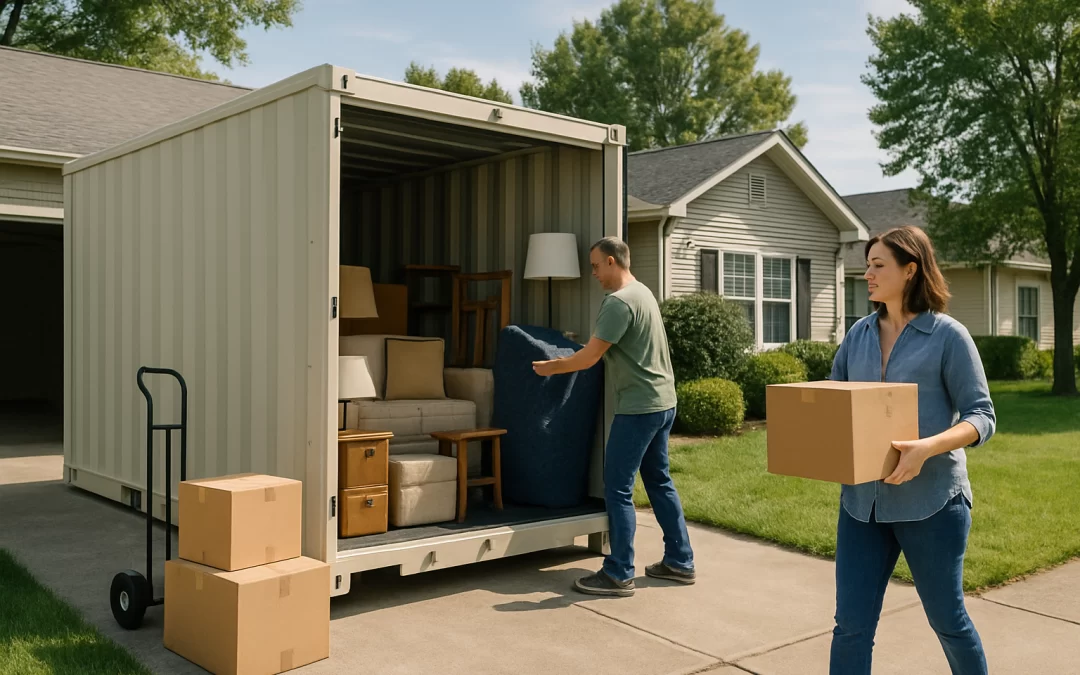
Portable storage units are weather-resistant containers delivered to your driveway so you can load your belongings at your own pace, then have the unit moved to your new home or to a storage facility. They typically cost between a few hundred dollars for a small local move and $2,000+ for long-distance moves, depending on size, distance, and storage time. They offer flexibility and can reduce the stress of moving day, but they require enough driveway or parking space and you still have to do the loading and unloading yourself unless you hire help.
For many families, portable storage units are a middle ground between renting a truck and hiring full-service movers. This guide explains how they work, what they cost, common mistakes to avoid, and how to decide if portable storage is right for your move. Use it to plan your timeline, budget realistically, and know when it makes sense to request moving quotes.
Table of Contents
- What Are Portable Storage Units and How Do They Work?
- Portable Storage Unit Sizes and Capacity
- Portable Storage Unit Costs and Pricing Factors
- Common Challenges and Mistakes with Portable Storage
- What to Do First: Step-by-Step Planning
- What to Expect: Timeline, Effort, and Logistics
- Portable Storage vs Hiring Movers vs DIY Truck
- How to Compare Moving and Portable Storage Quotes
- Ways to Save Money with Portable Storage Units
- What Can Go Wrong and How to Avoid It
- Frequently Asked Questions
- Summary and Next Steps
What Are Portable Storage Units and How Do They Work?
Portable storage units (often called “moving pods” or “storage containers”) are large, secure containers that a company delivers to your home. You load your belongings into the container, lock it, and then the company picks it up and either stores it or transports it to your new address.
They are popular for:
- Local moves where you want to spread packing over several days or weeks
- Long-distance moves when you do not want to drive a large truck
- Moves with a gap between move-out and move-in dates
- Renovations or temporary storage during home projects
Basic steps of using a portable storage unit
- Delivery: The company drops off the container at your home or building.
- Loading: You (or hired labor) load your boxes and furniture into the unit.
- Pickup: The company picks up the loaded container.
- Transport or storage: They either store it at their facility or deliver it to your new address.
- Unloading: You unload at your own pace, then schedule final pickup.
When portable storage units work best
- You want flexibility and do not want to rush everything into one moving day.
- You are comfortable doing your own packing and loading or hiring hourly labor.
- You have a driveway, parking pad, or safe street space for the container.
- You may need short-term or medium-term storage as part of your move.
Key limitations to keep in mind
- You still handle the physical labor unless you hire help.
- Some HOAs, apartment complexes, and cities restrict where containers can be placed.
- Access to your items is limited while the unit is in transit or at a storage facility.
- Costs can approach or exceed truck rental or even basic moving services for larger or long-distance moves.
If you are considering pods or containers specifically, it can help to review essential tips for using moving pods before you book.
Portable Storage Unit Sizes and Capacity
Portable storage units come in several standard sizes. Exact dimensions and capacity vary by company, but most follow a similar pattern.
Common portable storage unit sizes
- Small units (7–8 feet): Typically fit a studio or small 1-bedroom apartment (about 400–600 sq. ft.). Good for partial moves or decluttering.
- Medium units (10–12 feet): Often used for 1–2 bedroom apartments or small homes (about 600–1,000 sq. ft.).
- Large units (15–16 feet): Usually fit 2–3 bedroom homes (about 1,000–1,500 sq. ft.), depending on how much furniture you have.
- Extra-large or multiple units: For 3+ bedroom homes or if you have bulky items like pianos, large sectionals, or gym equipment.
How to estimate how many units you need
- List your biggest items: beds, sofas, dressers, appliances, tables, and outdoor furniture.
- Ask the container company for their recommended size based on your home size and inventory.
- When in doubt, lean slightly larger or plan for two smaller units instead of one overstuffed container.
- Remember that poor packing wastes space; careful stacking and using uniform boxes helps maximize capacity.
Weight limits and restrictions
- Each unit has a maximum weight limit; overloading can lead to extra fees or safety issues.
- Heavy items like safes, pianos, or large appliances may have special rules or may not be allowed.
- Hazardous materials (propane tanks, gasoline, chemicals, some paints) are usually prohibited.
Portable Storage Unit Costs and Pricing Factors
Portable storage unit pricing usually includes three main pieces: container rental, transportation, and storage (if needed). Costs vary widely by location, season, and distance.
Typical portable storage unit cost ranges
- Local move with short-term use (no long storage): Around $300–$800 for one container for a few days to a couple of weeks.
- Local move with 1–3 months of storage: Roughly $500–$1,500+, depending on container size and storage duration.
- Long-distance move with one container: Often $1,000–$3,000+, depending on distance, size, and storage time.
- Multiple containers or large homes: Costs can climb to $3,000–$6,000+ for long-distance moves with storage.
For comparison, typical moving costs look like this:
- Local move: $300–$1,500, depending on home size, hours, and number of movers.
- Long-distance move: $2,000–$8,000+ based on distance, weight, and services.
- Full-service moving (packing, loading, transport, unloading): Often higher than basic container or truck rental, but with far less physical work for you.
What affects portable storage unit pricing
- Distance: Longer transport routes cost more.
- Number and size of containers: More or larger units increase your total.
- Storage time: Monthly storage fees add up if your items stay in the facility for months.
- Location and season: High-demand cities and peak moving season (late spring through early fall) are usually more expensive.
- Access fees: Some companies charge each time you access your container at their facility.
Hidden fees to watch for
- Delivery and pickup fees at each location.
- Extended rental fees if you keep the unit longer than planned.
- Fuel surcharges or long-distance transport surcharges.
- Fees for rescheduling or last-minute changes.
- Damage or cleaning fees if the container is returned dirty or damaged.
How to get accurate cost estimates
- Have a clear list of your home size, approximate inventory, and move dates.
- Ask for a written quote that includes delivery, pickup, transport, and storage.
- Confirm any extra fees for access, extended rental, or changes to your schedule.
- Compare container quotes with quotes from traditional movers and truck rentals so you understand your options.
Common Challenges and Mistakes with Portable Storage
Portable storage units can simplify your move, but there are common pitfalls that can add stress or cost.
Common mistakes to avoid
- Underestimating space: Booking one container when you really need two, leading to last-minute scrambling and higher costs.
- Ignoring parking rules: Not checking with your city, HOA, or landlord and then being told the container cannot stay where you planned.
- Poor packing: Not using enough padding or straps, which can lead to shifting and damage during transport.
- Forgetting access needs: Packing items you might need (documents, seasonal clothing, tools) deep in the container and then not being able to reach them.
- Waiting too long to book: Containers can sell out during busy seasons, leaving you with fewer options or higher prices.
Challenges in apartments and tight spaces
- Limited parking or loading zones may not allow a container to sit for days.
- HOAs or building management may restrict portable units entirely or limit how long they can stay.
- You may need to use a mix of container plus a small truck or hand-carry items if the container cannot be placed close to your door.
If you are moving from or to an apartment, it can help to compare portable storage containers vs moving trucks for apartment moves so you understand the tradeoffs.
What to Do First: Step-by-Step Planning
A simple plan makes portable storage much easier to manage. Here is a practical order to follow.
Step 1: Confirm you can use a portable unit at both locations
- Check driveway or parking space at your current and new home.
- Ask your landlord, HOA, or building manager about rules and time limits.
- If street placement is needed, check with your city about permits.
Step 2: Estimate size and number of containers
- Use your home size and inventory as a guide (studio vs 3-bedroom, etc.).
- Talk to at least one or two container companies about their size recommendations.
- Decide whether you prefer one large unit or multiple smaller units.
Step 3: Get quotes and compare options
- Request written quotes from at least two container providers.
- Also request quotes from moving companies and, if you are open to it, compare with truck rental.
- Look at total cost, not just monthly rental: include delivery, pickup, storage, and any labor you might hire.
Step 4: Set your timeline
- Choose your container delivery date, ideally 1–2 weeks before your move-out if you want to load gradually.
- Schedule pickup for the day after your planned loading completion, with some buffer for delays.
- If you need storage, confirm how long your items will stay in the facility and when you want delivery at the new home.
Step 5: Plan packing and loading
- Gather boxes, tape, padding, and labels; using affordable supplies can help, and a cheap moving boxes guide can reduce costs.
- Decide whether you will load everything yourself or hire hourly labor.
- Plan to load heavier items on the bottom and toward the front (closest to the house) for stability.
What to Expect: Timeline, Effort, and Logistics
Knowing what the process looks like from start to finish can help you avoid surprises.
Typical timeline for using a portable storage unit
- 2–6 weeks before move: Research options, get quotes, and book your container and any movers or labor.
- 1–2 weeks before move: Container is delivered; you start loading non-essential items.
- Move-out week: Finish loading, lock the unit, and schedule pickup.
- During storage or transit: Container is stored at the company’s facility or transported to your new city.
- Move-in week: Container is delivered to your new home; you unload and then schedule final pickup.
How much effort to expect
- You are responsible for packing and loading unless you hire help.
- Loading a 2–3 bedroom home can take 1–3 full days for a couple of people, depending on how prepared you are.
- Hiring a small crew for a few hours can significantly reduce the physical strain and time.
Logistics details to clarify with the container company
- Exact delivery and pickup windows (morning, afternoon, or specific time).
- Where the container will be placed and how much space it needs.
- How to lock the unit and what type of lock is recommended or required.
- What happens if there is bad weather on delivery or pickup day.
Portable Storage vs Hiring Movers vs DIY Truck
Choosing between portable storage, full-service movers, and a DIY truck rental depends on your budget, time, and physical ability.
Portable storage units: pros and cons
- Pros:
- Flexible loading and unloading schedule.
- No need to drive a large truck long distances.
- Built-in storage if there is a gap between homes.
- Often cheaper than full-service movers for some long-distance moves.
- Cons:
- You still do the heavy lifting unless you hire labor.
- Requires space and permission to place the container.
- Costs can add up with multiple units or long storage times.
Full-service movers: pros and cons
- Pros:
- They handle loading, driving, and unloading.
- Faster and less physically demanding for you.
- Professional packing and protection options available.
- Cons:
- Usually more expensive than DIY or basic container rental.
- Less flexibility on timing; you work around their schedule.
- You may have fewer opportunities to access your items during transit.
DIY truck rental: pros and cons
- Pros:
- Often the lowest upfront cost for local moves.
- Full control over timing and route.
- Good for short distances and smaller loads.
- Cons:
- You drive the truck, which can be stressful, especially long-distance.
- You handle all loading and unloading.
- Fuel, mileage, and insurance can add significantly to the base price.
Which option fits your situation?
- Choose portable storage if you want flexibility, do not want to drive a big truck, and are okay doing (or hiring) the loading.
- Choose full-service movers if you have a larger home, limited time, physical limitations, or you want the least physical work.
- Choose DIY truck rental if your move is local, you are comfortable driving a truck, and your main priority is minimizing cost.
If you are still weighing containers against traditional trucks, you may find it helpful to review storage pods vs moving trucks pros and cons in more detail.
How to Compare Moving and Portable Storage Quotes
Comparing quotes is one of the most important steps in controlling your moving costs and choosing the right service.
When to get quotes
- For local moves, start getting quotes 4–6 weeks before your move date.
- For long-distance or peak-season moves, aim for 6–10 weeks in advance.
- If you are moving last-minute, you may still find options, but expect higher prices and less availability.
How many quotes to compare
- Get at least 3 quotes from a mix of providers (portable storage, movers, and possibly truck rental).
- Make sure each quote includes the same basic services so you are comparing fairly.
What to look for in a portable storage quote
- Container size and number of units included.
- Delivery and pickup fees at each address.
- Monthly rental and storage fees.
- Transport charges for long-distance moves.
- Any extra fees for access, rescheduling, or extended rental.
What to look for in a moving company quote
- Whether the quote is binding (fixed) or non-binding (estimate only).
- What is included: labor, truck, fuel, basic protection, packing materials.
- Extra charges for stairs, long carries, heavy items, or narrow access.
- Cancellation or rescheduling policies.
How to get more accurate estimates
- Provide a detailed inventory or allow a virtual or in-home walkthrough.
- Be honest about stairs, elevators, parking distance, and any special items.
- Share your ideal dates but also ask about flexible date discounts if your schedule allows.
Ways to Save Money with Portable Storage Units
You can often reduce your total moving cost with a few smart choices and some planning.
Practical ways to cut costs
- Declutter before you pack: The less you move, the fewer containers or trips you need.
- Choose the right timing: If possible, avoid peak weekends and end-of-month dates when demand is highest.
- Limit storage time: Plan your move so your container spends fewer months in storage.
- Pack efficiently: Use uniform boxes and fill gaps to maximize space and reduce the number of containers.
- Hire labor only where needed: Consider a small crew for heavy items while you handle lighter boxes.
Balancing savings with convenience
- Sometimes paying a bit more for help with loading can prevent injuries and speed up your move.
- Compare the total cost of container + labor vs a full-service mover; the difference may be smaller than you expect.
- Factor in your time, energy, and stress level when deciding how much to DIY.
What Can Go Wrong and How to Avoid It
Most portable storage moves go smoothly, but it is wise to plan for potential issues.
Potential problems
- Container cannot be placed: The driver arrives but there is not enough space or permission to drop the unit.
- Weather delays: Heavy snow, ice, or storms can delay delivery or pickup.
- Damage to items: Poorly packed or unsecured items can shift during transport.
- Scheduling conflicts: Miscommunication about dates can leave you without your container when you need it.
- Unexpected fees: Extra charges appear for extended rental, access, or changes.
How to reduce your risk
- Confirm placement details and any permits in writing before delivery.
- Build a small buffer into your timeline in case of delays.
- Use straps, padding, and careful stacking to protect your belongings.
- Double-check all dates and times with the container company a few days before each step.
- Read the contract so you understand fees, insurance options, and what is covered in case of damage.
Frequently Asked Questions
How much does a portable storage unit cost for a local move?
For a local move, a single portable storage unit typically costs between $300 and $800 for short-term use, including delivery and pickup. If you need storage for one or more months, expect the total to be closer to $500–$1,500+ depending on size and duration.
Are portable storage units cheaper than hiring movers?
Portable storage units can be cheaper than full-service movers, especially if you are willing to do your own packing and loading. However, once you add storage time and any hired labor, the total cost can be similar to or even higher than a basic moving service, so it is important to compare quotes.
How long can I keep a portable storage unit at my house?
Most companies allow you to keep the unit at your home for several days to a few weeks as part of the standard rental. Longer on-site time is usually possible for an additional daily or monthly fee, as long as your city or HOA rules allow it.
Can I access my stuff while the portable unit is in storage?
In many cases, you can access your container at the company’s storage facility, but you may need to schedule an appointment and pay an access fee. If you think you will need frequent access, ask about policies and fees before you book.
Do portable storage units work for apartment moves?
They can work for apartments, but parking and building rules are critical. You may need permission to place the container in a lot or loading area, and in some cases a traditional moving truck or a mix of options will be more practical.
When should I book a portable storage unit?
Ideally, book 4–8 weeks before your move, especially during busy seasons like summer and end-of-month dates. Booking early gives you better availability, more time to compare prices, and a smoother planning process.
Summary and Next Steps
Portable storage units offer a flexible way to move, combining transportation and storage in one service. Costs for local moves often range from a few hundred dollars to around $1,500+, while long-distance moves with storage can run from about $1,000 to several thousand dollars depending on size, distance, and time in storage.
To decide if portable storage is right for you, compare container quotes with traditional moving and truck rental options, and think about how much physical work you are comfortable doing. Getting multiple moving quotes and planning several weeks ahead will help you control costs, reduce stress, and choose the option that best fits your home, budget, and timeline.
About the Author
This article was written by the team at Rex Direct, the owners of QuickMovingQuotes.com.
Rex Direct supports businesses and consumers throughout the moving industry by providing technology and data solutions that help homeowners compare moving services, understand pricing, and make informed relocation decisions.
Through their work with movers, relocation platforms, and lead generation services, the Rex Direct team has developed extensive insight into how interstate moving companies operate and how consumers can protect themselves during the moving process.